
Caulfield Grammar School 1974, Western Front 2025
When I was 14, I appeared in a school production of Oh, What A Lovely War!
At the time I rather fancied myself as a performer but in this show I was very much an extra: a chorus line soldier, a minor non-speaking Austrian diplomat and a newsboy. It was this last role that supplied my best line, “Russia mobilises, Russia mobilises!”
The musical is an English satire on World War I, written in the early 1960s when memories of the war were still strong and painful. The professional London cast wore pierrot suits and military caps, while we Melbourne schoolboys wore our cadet uniforms and long khaki socks to replicate puttees. Close enough.
The play was a passion project for our director, a senior master who taught European History. My understanding of World War I was minimal, limited (maybe) just to the myths of Gallipoli. I had yet to learn about assassinated arch-dukes, mud-filled trenches, barb-wire defences and mustard gas. I had no idea what I was warbling about during company numbers such as ‘Belgium Put the Kibosh on the Kaiser’ or ‘Far, Far from Wipers’.
I wasn’t much good in the spotlight, more concerned about not smirking at familiar faces I spotted in the front rows. I could hold a tune but with a voice yet to break my contributions to songs such as ‘Old Soldiers Never Die’ and ‘Are We Downhearted?’ were unconvincing.
The best part was that we had real girls from the neighbouring girls’ school taking the female leads, and we shared the changing rooms with these mysterious creatures.
I knew my mother’s father had fought in WWI. He returned home suffering the effects of gas poisoning and died young. Mum didn’t like discussion about the war as it prompted memories of her weakened father. Dad had an uncle who survived four years at the front, only to lose his life in an accident when coming home in 1919. He also had a maiden aunt who would talk wistfully of the young men she had known before the war who didn’t come home.
Years later I majored in European History at university, one stream of which was Imperialism and the 19th Century upheavals that led to the first great war of the 20th Century. I came to understand that WWI was an outrage, started by weak and greedy governments; there was no practical reason for Australia to have been involved. Millions of men, mostly from the working classes, were callously sacrificed.
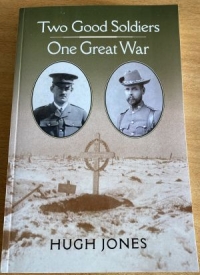 I never thought that one day I would write a book about the war, or at least about two of its soldiers. My small, family-oriented story about my Tasmanian great grandfather and his family’s young, football-hero boarder was published in 2024. I had spent more than three years researching and writing about these men, one of whom was at the Gallipoli landing but died later on the Western Front, and the other who was denied the opportunity to enlist, which he regretted until the day he died. Reading dozens of personal letters and contemporary papers helped me come to know these individuals, both of whom were good lives wasted.
Promoting and marketing the book has been a rewarding experience. I’ve met many good people, all fascinated by the events of 1914-18. Some have their own personal links that impact their lives, such as memories of unexplained sorrow and anguish seen in their grandparents, or of revered photos of family members who never came home. I’ve given talks about my story to groups in three states. I’ve been touched by some who travelled long distances to meet me and share their own stories.
I visited the Western Front in 2025, to see for myself the sites of such unimaginable carnage. I stood on the 1916 Allied front line of the Somme, walked the fields around Pozieres, which historian C.W. Bean said were “more densely sown with Australian sacrifice than any other place on earth”, and picked red poppies in the fields outside Villers-Bretonneux. In northern Belgium, I visited the rebuilt Ypres, which as a schoolboy I had not linked to “Wipers”, stood on Broodseinde Ridge to view distant Passchendaele, and walked through Polygon Wood – all battlefields soaked in Australian blood.
For many decades I’d forgotten about my minor role in Oh, What a Lovely War but writing about World War I and visiting northern France stirred the memories, to the point I can remember the songs and many of the lines. Much that I didn’t understand in 1974 has been explained and become very real. I can see why this unnecessary and brutal conflict was so right for satire.
Oh, What a Lovely War indeed. It was a farce. A tragedy. A disgrace.
Stereo Story 904
Two Good Soldiers, One Great War by Hugh Jones.
Hugh Jones

Hugh Jones worked for News Limited in Australia for more than 20 years in a wide variety of editorial roles, including as a newspaper editor. He has also worked in the United Kingdom, both in London and the provinces. He has also worked in public relations and strategic communications, The author of Two Good Soldiers, One Great War (Forty South, 2024), Hugh was president of the Williamstown Literary Festival for several years. He has been a long time supporter of, and contributor to, Stereo Stories
Leave A Comment